




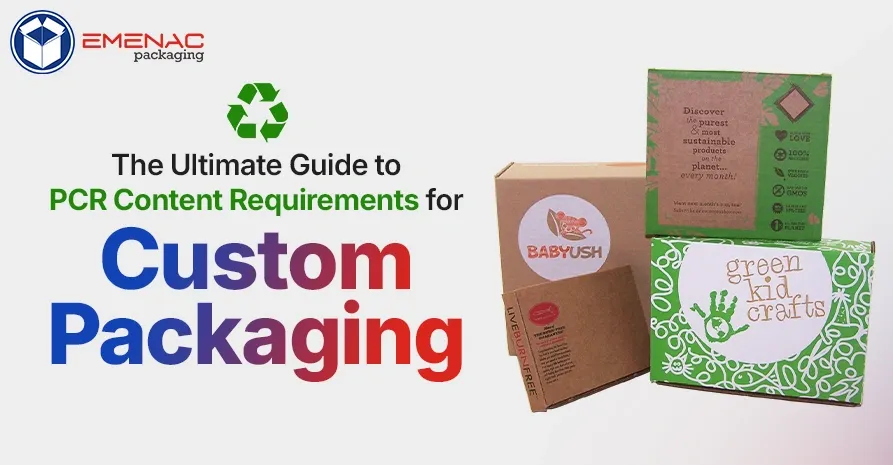
The Ultimate Guide to PCR Content Requirements for Custom Packaging
Sustainability has now become a compulsion for brands not only to protect the environment, but also due to the increasing demands of eco-conscious customers. Have you been familiarized with the term “PCR” before? If not, continue reading.
PCR, or post-consumer recycled packaging, is the process of converting used materials into new ones, providing a substantial reduction in waste generation. In this blog post, we will discuss the PCR content requirements for custom packaging.
What Counts as PCR & What Doesn't in Custom Packaging?
This confuses people. PCR has to come from customers. The technical term used for industry scrap is known as PIR, which means post-industrial recycled content. It is also a recycled material and far better than plastic, but it can’t be like PCR.
States specifically wrote their laws to require post-consumer material because that's what creates a market for actual recycling programs.
Think of it this way: if factories could just use their own leftover plastic trimmings to meet requirements, nothing would change. The goal is to pull material out of the waste stream that consumers generate, not just reuse manufacturing scraps.
Current State Requirements You Need to Track
All over the U.S., the state of California made the move first and went aggressive. Back in 2022, beverage bottles needed 15% PCR, and this year, it jumped to 25%, and most probably, it will reach 50% in 2030.
Washington joined in and required almost 15% PCR. The other remaining sites have their own laws and rules. But things become a little bit worse at the stage where brands know each state has its own rules.
If you want to sell your products in multiple states, you should be aware of the rules of each state separately. It’s quite difficult to pick the rules of just one state and call it done. Colorado and Minnesota are tying PCR goals into their Extended Producer Responsibility programs, which adds another layer.
Why Brands Are Missing Their Targets?
Big brands announced that they will reach more than 25% PCR across all packaging by 2026. Most can’t make it because from 2018 to 2023, the recycled content went from roughly 5% to 13%.
Basically, the real problem is not about a lack of effort, but it is hard to find food-grade PCR. The material should be like that is safe and efficient for food items and should not be harmful to the food’s taste, but this requires serious processing infrastructure.
Food-grade PCR costs two or three times more than regular packaging material. But when you put your efforts into acquiring that material, you will not regret it ever.
The 2030 and Beyond Timeline
Thinking, 2030 requirements are challenging or tough? Stop for a while. California's beverage bottle mandate climbs to 50% by 2030. The EU is requiring 30% PCR in single-use plastic beverage bottles by 2030 and 65% by 2040.
Minnesota recently passed a law that all types of packaging must be reusable or recyclable by 2032. That’s a complete system overhaul for most brands.
The EPR program of Colorado charges eco-modulation fees that reward those who take eco-friendly practices seriously and penalize those who don’t. Other states are also trying to copy that model, but it will take time. Undoubtedly, this game is long but worth the beneficial for brands.
How to Actually Comply?
- First, you need to audit what you are using. Also, figure out which state laws you want to comply with.
- Must discuss with your packaging supplier regarding PCR availability. We advise against going if your packaging supplier does not have enough planning for PCR.
- Redesign your brand packaging and use those materials that can be easily recycled.
- Join industry groups where PCR is a trending topic. Collaborate with them to discuss more in more detail that will help you in finding which approach would work best.
- Build PCR sourcing into your long-term planning now. Prices will likely stay elevated for a while, so budget accordingly.
In Summary!
PCR content requirements represent a fundamental shift in how custom packaging is designed and implemented. The future is clear: only those brands will survive who take eco-friendly practices seriously.
Undoubtedly, it's more expensive right now; supply is limited, which complicates your sourcing. But the regulatory momentum is clear, and consumer expectations are pushing in the same direction. So, start small and grow faster with time with Emenac Packaging USA.

Having an ability to customize packaging boxes in different sizes, shapes and styles, Emenac Packaging fulfills the requirement of customers in lowest rate with flawless printed results. Not only we accept short and long run orders, we also use high quality Cardboard, Kraft and Corrugated materials to give you unrivaled printing and packaging solutions.
Share This


 6 Packaging Details That Make Halloween Deliveries Extra Spooky
 Columbus Day 2025 – Culture, Controversy & Commemorations
 How to Safely Ship Candles Without Breakage or Heat Damage?
 Client Appreciation Gifts: A Powerful Retention Strategy
 How QR Codes and NFC Tags Drive Customer Loyalty Through Packaging?