





What Are Carbon Labels & Why Should Your Packaging Have One?
There is an invisible change going on when it comes to consumer shopping behavior. It does not happen overnight. There is no one particular point in time where you could mark down when this trend began.
However, when you look at the bigger picture, you will see that more consumers are taking the time to pick up a product and flip it around to search for more than just its nutritional content and cost value.
They want to know that the brand that produced the product is passionate enough to make a difference in our environment. Carbon labels are slowly becoming the evidence that these consumers are searching for.
This blog post is going to define what are carbon labels and why your packaging should have one.
What are Carbon Labels?
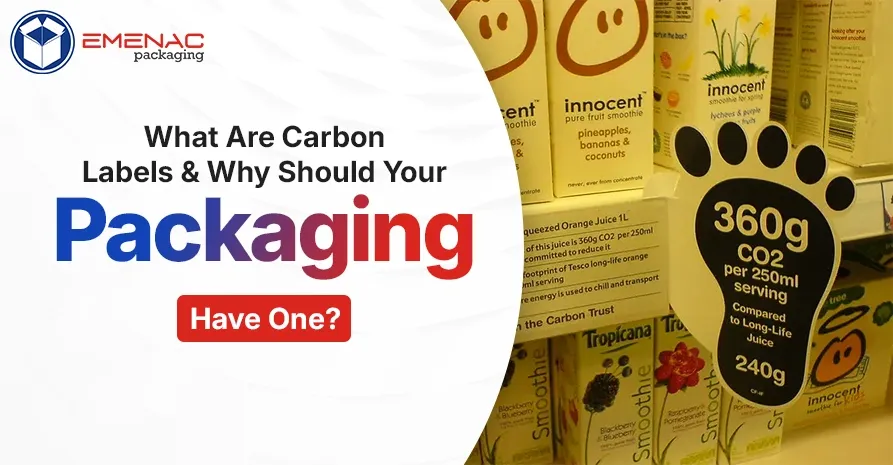
The carbon label is a statement that is printed on the product packaging, which states how much carbon emissions are created when producing the product throughout its entire life cycle.
The emissions include those associated with manufacturing, sourcing materials, transporting the product, etc.
The value stated in the label is always presented in CO₂ equivalents and is sometimes abbreviated as CO₂e. In fact, it works just as the food label, which tells us about the calorific content of the food, but instead, we can learn about the impact on our planet.
In some cases, the label shows only one value; in other instances, it presents an assessment scale that is somewhat similar to energy rating on various electrical devices, and enables one to determine whether the product has high or low carbon footprint.
Where Did Carbon Labels Come From?
This notion is far from novel. Carbon labeling became an emerging practice in the mid-2000s, initially introduced in the UK and parts of Europe.
Some of the leading consumer brands on a global scale have tried their hand at carbon labeling over the years, while some governments have been trying to encourage its wider use.
What has happened is that there is more urgency to the matter. The climate issue has gained a lot of public prominence, and so has consumers' call for more transparency. While the practice of carbon labeling used to be a luxury for green-minded buyers, it is now becoming more mainstream.
Why Does This Matter for Packaging Specifically?
Packaging is a very clear and physical interaction point for a brand and its customers. This is how they can interact with the product without experiencing it yet. In other words, packaging presents unique opportunities for brands to communicate their environmental initiatives.
By placing a carbon footprint on packaging, companies demonstrate transparency at a level that most businesses have yet to reach. They show their customers that they are not afraid to take responsibility and are trying to minimize negative effects.
Such an approach helps to build credibility that generic eco-friendly messages cannot. It takes more than putting the words on a package; it takes numbers to back them up.
The Business Case for Carbon Labels
Apart from the environmental considerations, however, the business case for introducing a carbon label to your packaging grows stronger with each passing day.
The behavior of modern consumers is evolving at an even quicker rate than brands think possible.
Research shows that a substantial percentage of consumers, especially young ones, make their purchase choices based on how environmentally friendly companies operate. They are ready to pay extra for brands that prove themselves to be sustainable. This kind of labeling is one such proof.
Furthermore, carbon labeling makes your brand stand out among competitors. Modern retail environments are overcrowded and very competitive.
Any opportunity to create that moment when a consumer stops and engages with your product is precious. A carbon label speaks volumes about your brand and its attitude towards sustainability, without any need for words.
Finally, there is the regulatory aspect. Many regions increase their requirements for businesses' sustainability and introduce new mandatory reporting requirements.
Your business might soon face the need to calculate, report on, and reduce the carbon footprint it creates in the process of its activity. Being proactive now can pay off greatly later on.
What About Greenwashing Concerns?
Indeed, it is a fair point worth exploring further. Greenwashing is certainly a problem and an increasingly prevalent one at that. Governments of several countries have begun stepping up action against greenwashing, while consumers have begun taking such practices with a grain of salt, especially when there is no substantiation to the broad sustainability claims made by companies.
On the contrary, carbon labels are part of the solution to this problem. A certified carbon label is an objectively obtained measurement of the product lifecycle, not a claim made to enhance brand reputation. Again, this is what separates a claim from proof.
Use accredited certifying organizations when implementing such labeling, and ensure that you follow existing standards when measuring the lifecycle of the product.
Ending Remarks!
What are carbon labels? It is not about carbon labeling as a gimmick, and it is not limited only to the largest companies or specialized eco-labels.
Carbon labels have become a reliable, practical, and required method of demonstrating responsibility towards the environment by any brand.
Your packaging already speaks for itself. Just make sure that it says what it needs to say.
Would you like to discover sustainable packaging solutions for your brand? Contact Emenac Packaging USA, and we will help you to create something really valuable for your customers and the planet.

Having an ability to customize packaging boxes in different sizes, shapes and styles, Emenac Packaging fulfills the requirement of customers in lowest rate with flawless printed results. Not only we accept short and long run orders, we also use high quality Cardboard, Kraft and Corrugated materials to give you unrivaled printing and packaging solutions.
Share This


 6 Packaging Details That Make Halloween Deliveries Extra Spooky
 Columbus Day 2025 – Culture, Controversy & Commemorations
 How to Safely Ship Candles Without Breakage or Heat Damage?
 Client Appreciation Gifts: A Powerful Retention Strategy
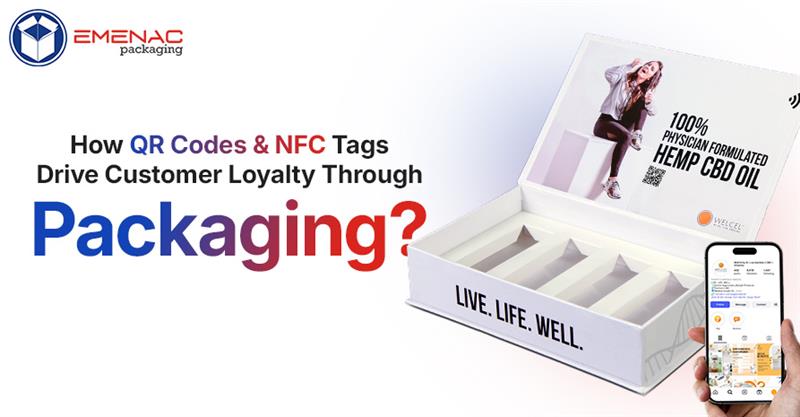 How QR Codes and NFC Tags Drive Customer Loyalty Through Packaging?